docs/cli-examples
hwylterm CLI Examples
| CLI | Description |
|---|---|
| allFlagKinds | The flag DSL supports multiple equivalent syntaxes — this shows all of them side by side. |
| collections | Various collection types (seq/sets) allow for repeated flags or delimited values |
| customHelp | The help renderer can be replaced entirely by overriding the render procs before the hwylCli macro. |
| customParse | customize parsing of typical types and with distinct types |
| defaults | Flags can carry default values of any supported type, shown in help output automatically. |
| defaultsSub | Global flags with defaults and env var inference flow through to subcommands unchanged. |
| enumFlag | Nim enum types work directly as flag types, with automatic error messaging for invalid values. |
| flagKVs | Key=value pair flags let you accept structured input like --flag key=value in a single argument. |
| flagKey | Bool flags are the default type — no type annotation needed, just a name and help string. |
| flagObject | Flags can be objects ,including with their own collection types (seq, set, etc.) |
| flagSeparators | String flags accept both --flag value and --flag=value — either separator works. |
| flagSettings | Individual flags can opt out of default help display, and Count gives an incrementing integer flag. |
| generateOnly | GenerateOnly lets you run arbitrary code before the CLI starts, then invoke the parser manually. |
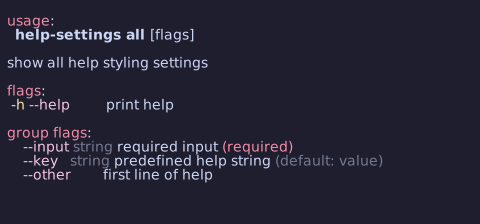
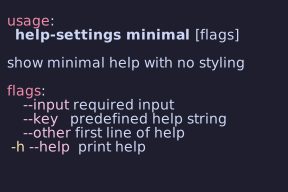
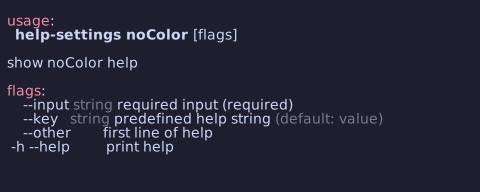
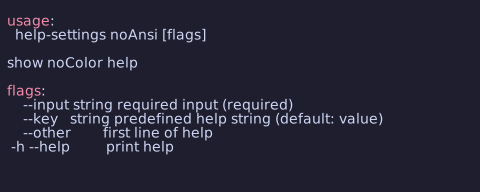
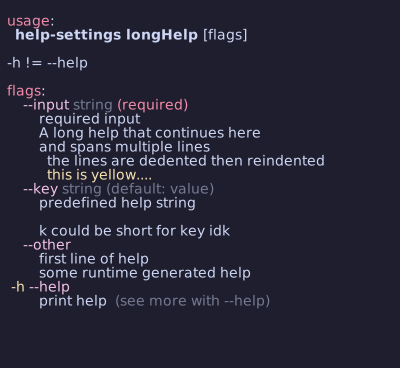
| helpSettings | Builtin style presets let you switch the entire help appearance without manual style configuration. |
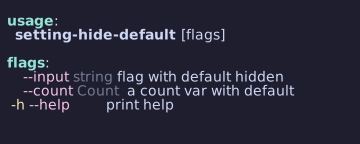
| hideDefaultSetting | HideDefault on the CLI hides all flag defaults from help at once, without per-flag annotation. |
| inferEnv | InferEnv automatically binds CMDNAME_FLAGNAME environment variables to their flags. |
| inferShort | InferShort generates a short flag from the first letter of each long flag name automatically. |
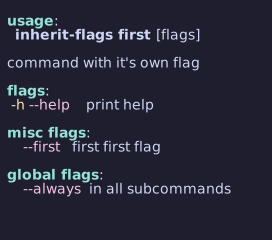
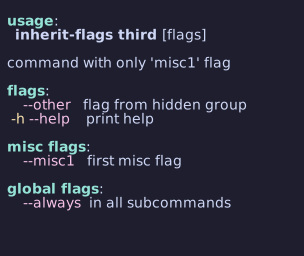
| inheritFlags | Flag groups let subcommands selectively pull in flags from the parent using the ^ syntax. |
| multiShortFlags | Single-letter flag names are automatically short-only — no long form is generated. |
| posBasic | Positional arguments can bind to a different variable name in the run block via ident. |
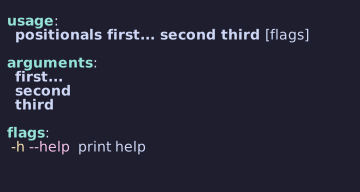
| posFirst | A variadic positional can appear first, collecting values until the fixed positionals are satisfied from the right. |
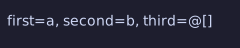
| posLast | A variadic positional in the last position collects all remaining arguments after the fixed ones. |
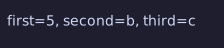
| posNoMulti | Positionals with non-seq types accept exactly one value each and support type coercion. |
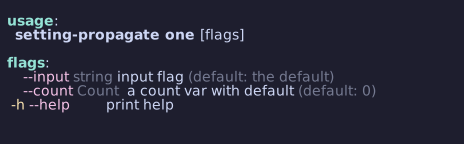
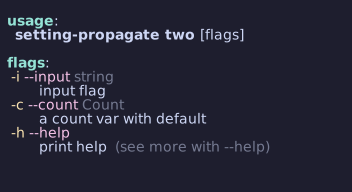
| propagateSetting | Settings flow down to subcommands by default; IgnoreParent opts out and per-subcommand settings extend or replace. |
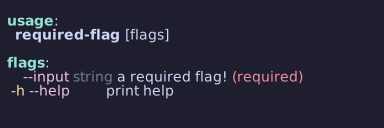
| required | Marking a flag Required causes the CLI to exit with an error if it is not provided. |
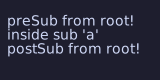
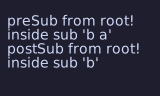
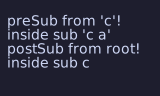
| subHooks | preSub and postSub hooks run code around any subcommand dispatch, and can be nested per level. |
| subcommands | Subcommands each have their own flags, positionals, aliases, and can use hyphenated names. |
| version | Versions can be set using compile time defines or runtime code |
allFlagKinds
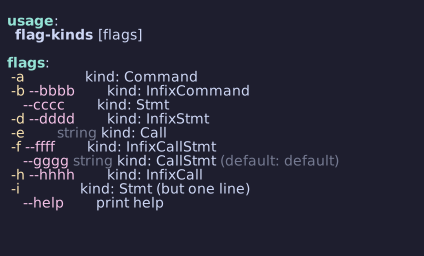
## The flag DSL supports multiple equivalent syntaxes — this shows all of them side by side.
import std/strformat
import hwylterm, hwylterm/hwylcli

hwylCli:
  name "flag-kinds"
  flags:
    a "kind: Command"
    b | bbbb "kind: InfixCommand"
    cccc:
      ? "kind: Stmt"
    d | dddd:
      ? "kind: InfixStmt"
    e(string, "kind: Call")
    f | ffff("kind: InfixCallStmt"):
      ident notffff
    gggg(string, "kind: CallStmt"):
      * "default"
    h | hhhh("kind: InfixCall")
    i: "kind: Stmt (but one line)"
  run:
    echo fmt"{a=}, {bbbb=}, {cccc=}, {dddd=}"
    echo fmt"{e=}, {notffff=}, {gggg=}, {hhhh=}, {i=}"
Case 1 (ok)
allFlagKinds --help
collections
## Various collection types (seq/sets) allow for repeated flags or delimited values

import std/strformat
import hwylterm, hwylterm/hwylcli

type
  Mode = enum
    fun, sad, angry, sleepy

hwylCli:
  name "collects"
  flags:
    inputs(seq[string], "sequence of inputs")
    modes(set[Mode], "set of modes")
    modes2(toHashSet([fun]), HashSet[Mode], "hashset of modes")
    outputs(seq[KVstring], "sequence of key/value pairs")
  run:
    echo fmt"{inputs=},{modes=},{modes2=},{outputs=}"
Case 1 (ok)
collections --inputs one --inputs two --inputs three --modes fun --modes sad \
  --outputs:first:first.txt --outputs:second=second.txt

Case 2 (ok)
collections --inputs one --inputs,=two,three --modes,=,fun,sad,fun --modes2 sad --modes2 sleepy \
  --outputs,:first:first.txt,second:second.txt

customHelp
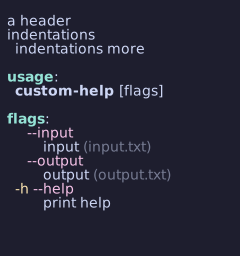
## The help renderer can be replaced entirely by overriding the render procs before the hwylCli macro.
import std/[strutils,strformat, sequtils]
import hwylterm
import hwylterm/hwylcli except renderHeader


# TODO: actually implement this in bbansi
func stripMarkup*(s: string): string =
  result = bb(s).plain

func render*(cli: HwylCliHelp, f: HwylFlagHelp): string =
  result.add "  "
  if f.short != "":
    result.add "[" & cli.styles.flagShort & "]"
    result.add "-" & f.short.alignLeft(cli.lengths.shortArg)
    result.add "[/" & cli.styles.flagShort & "]"
  else:
    result.add " ".repeat(1 + cli.lengths.shortArg)
  result.add " "

  let indentSize = stripMarkup(result).len
  if f.long != "":
    result.add "[" & cli.styles.flagLong & "]"
    result.add "--" & f.long.alignLeft(cli.lengths.longArg)
    result.add "[/" & cli.styles.flagLong & "]"
  else:
    result.add " ".repeat(2 + cli.lengths.longArg)

  result.add "\n"
  result.add " ".repeat(indentSize + 4)
  if f.description != "":
    result.add "[" & cli.styles.flagDesc & "]"
    result.add f.description
    result.add "[/" & cli.styles.flagDesc & "]"
    if f.defaultVal != "":
      result.add " "
      result.add "[" & cli.styles.default & "]"
      result.add "(" & f.defaultVal & ")"
      result.add "[/" & cli.styles.default & "]"

func render*(cli: HwylCliHelp, flags: seq[HwylFlagHelp]): string =
  result.add "flags".bbMarkup(cli.styles.header)
  result.add ":\n"
  result.add flags.mapIt(render(cli, it)).join("\n")

hwylCli:
  name "custom-help"
  defaultFlagType string
  help:
    header """
     a header
    indentations
      indentations more
    """
  flags:
    input:
      ? "input"
      * "input.txt"
    output:
      ? "output"
      * "output.txt"
  run:
    echo fmt"{input=},  {output=}"
Case 1 (ok)
customHelp --help
customParse
## customize parsing of typical types and with distinct types
import std/[os, paths, strformat]
import hwylterm, hwylterm/hwylcli

type
  Input = distinct string
  Data = object
    nums: seq[int]
    names: seq[string]

proc `$`(v: Input): string {.borrow.}
proc parse(p: OptParser, target: var Input) =
  checkVal p
  if not p.val.fileExists:
    hecho "warning input file does not exist: " & p.val
  target = Input(p.val)

proc parse(p: OptParser, target: var Path) =
  checkVal p
  target = Path(p.val)

proc fieldNames(o: object): seq[string] =
  for k, _ in o.fieldPairs: result.add k

proc parse(p: var OptParser, target: var object) =
  let key = extractKey(p)
  if key notin target.fieldNames:
    hecho "ignoring unknown key: " & key
    return
  for name, field in target.fieldPairs:
    if name == key:
      parse(p, field)
      return

hwylCli:
  name "customParse"
  flags:
    input(Input, "some input")
    output(Path, "some output")
    data(Data, "data")
  run:
    echo fmt"{input=},{output=}"
    echo data
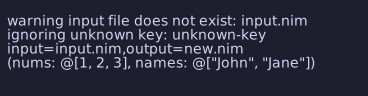
Case 1 (ok)
customParse --input input.nim --output new.nim --data:unknown-key:val --data,=nums:1,2,3 \
  --data:names:John --data:names:Jane
defaults
## Flags can carry default values of any supported type, shown in help output automatically.
import std/[strformat]
import hwylterm, hwylterm/hwylcli

hwylCli:
  name "default-values"
  flags:
    input:
      T string
      * "testing"
      ? "some help after default"
    outputs:
      T seq[string]
    count:
      T int
      * 5
      ? "some number"
  run:
    echo fmt"{input=} {outputs=}, {count=}"
Case 1 (ok)
defaults

defaultsSub
## Global flags with defaults and env var inference flow through to subcommands unchanged.
import std/[os, strformat]
import hwylterm, hwylterm/hwylcli

putEnv("DEFAULTS_SUB_COUNT", "15")
putEnv("DEFAULTS_SUB_OUTPUTS", ",a,b,c")

hwylCli:
  name "defaults-sub"
  settings InferEnv
  flags:
    [global]
    input:
      T string
      * "testing"
      ? "some help after default"
    outputs:
      T seq[string]
    count:
      T int
      * 5
      ? "some number"
  subcommands:
    [a]
    run:
      assert count == 15
      echo fmt"{input=}, {outputs=}, {count=}"
Case 1 (ok)
defaultsSub a

enumFlag
## Nim enum types work directly as flag types, with automatic error messaging for invalid values.
import std/[strformat]
import hwylterm, hwylterm/hwylcli

type
  Color = enum
    red, blue, green

hwylCli:
  name "enumFlag"
  flags:
    color:
      T Color
  run:
    echo fmt"{color=}"
Case 1 (ok)
enumFlag --color red

Case 2 (error)
enumFlag --color black

flagKVs
## Key=value pair flags let you accept structured input like --flag key=value in a single argument.
import hwylterm, hwylterm/hwylcli


type Inputs = KVString

proc `$`(_:typedesc[seq[KVString]]): string =
  "k(str):v(str)..."

hwylCli:
  name "flagKVs"
  flags:
    inputs(seq[Inputs], "version with type alias")
    counts(KV[string, int], "key value, custom types")
    builtins(seq[KVstring], "one using provided type")
  run:
    echo counts.key,":", counts.val
    for (k, v) in inputs:
      echo k, ":", v
    for item in builtins:
      echo item
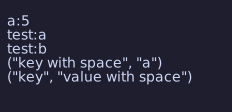
Case 1 (ok)
flagKVs --counts a:5 --inputs "test:a" --inputs "test:b" --builtins,=,"key with space:a,key:value \
  with space"
flagKey
## Bool flags are the default type — no type annotation needed, just a name and help string.
import hwylterm, hwylterm/hwylcli

hwylCli:
  name "base"
  flags:
    key "a flag named 'key'"
  run:
    if key:
      echo "key set"
    else:
      echo "key not set"
Case 1 (ok)
flagKey --key

flagObject
## Flags can be objects ,including with their own collection types (seq, set, etc.)

import hwylterm, hwylterm/hwylcli

type
  Person = object
    name: string
    age: int
    weight: float = 150.5
    roles: seq[string]

hwylCli:
  name "flagObject"
  flags:
    person(Person, "a person")
  run:
    echo person
Case 1 (ok)
flagObject --person:name:John --person,=roles=admin,user

Case 2 (ok)
flagObject --person name:John --person:age=25 --person:weight:160

Case 3 (error)
flagObject --person:nonexistient:error

flagSeparators
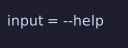
## String flags accept both --flag value and --flag=value — either separator works.
import hwylterm, hwylterm/hwylcli

hwylCli:
  name "flag-separators"
  flags:
    input(string, "flag that expects some input")
  run:
    echo "input = ", input
Case 1 (error)
flagSeparators --input --help

Case 2 (ok)
flagSeparators --input=--help
flagSettings
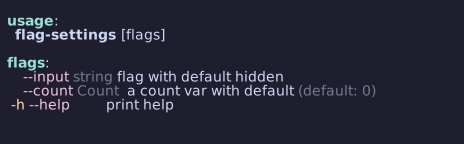
## Individual flags can opt out of default help display, and Count gives an incrementing integer flag.
import hwylterm, hwylterm/hwylcli

hwylCli:
  name "flag-settings"
  flags:
    input:
      S HideDefault
      T string
      * "a secret default"
      ? "flag with default hidden"
    count:
      T Count
      * Count(val: 0)
      ? "a count var with default"
  run:
    discard
Case 1 (ok)
flagSettings --help
generateOnly
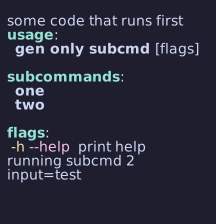
## GenerateOnly lets you run arbitrary code before the CLI starts, then invoke the parser manually.
import std/[os, strformat]
import hwylterm/hwylcli


hwylCLi:
  name "gen only"
  settings GenerateOnly, ShowHelp
  subcommands:
    [one]
    positionals:
      args seq[string]
    run:
      assert args == @["a", "b", "c"]
      echo fmt"{args=}"

    [two]
    flags:
      input(string, "someinput")
    run:
      echo "running subcmd 2"
      echo fmt"{input=}"

echo "some code that runs first"

printGenOnlyHelp()
if paramCount() == 0:
  let args = parseCmdLine("two --input test")
  runGenOnly(args)
else:
  # use from parseCommandLine
  runGenOnly()
Case 1 (ok)
generateOnly one a b c
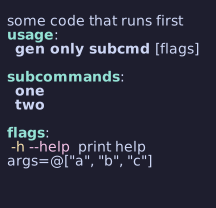
Case 2 (ok)
generateOnly
helpSettings
## Builtin style presets let you switch the entire help appearance without manual style configuration.
import std/[os, strformat]
import hwylterm, hwylterm/hwylcli

putEnv("HWYLCLISTYLES_HEADER","red")
# putEnv("HWYLCLISTYLES_SETTINGS", "Aliases")

const identHelp = """predefined help string

k could be short for key idk
"""

proc helpRuntime(s: string): string =
  result = s & """

some runtime generated help
"""


hwylCli:
  name "help-settings"
  flags:
    [group]
    input:
      T string
      ? """
      required input
      A long help that continues here
      and spans multiple lines
        the lines are dedented then reindented
        [yellow]this is yellow....[/]
      """
      S Required
    key:
      T string
      ? identHelp
      * "value"
    other:
      ? helpRuntime("first line of help")
  subcommands:
    [all]
    ... "show all help styling settings"
    help:
      styles: fromBuiltinHelpStyles(AllSettings)
    flags: ^[group]

    [minimal]
    ... "show minimal help with no styling"
    help:
      styles: fromBuiltinHelpStyles(Minimal)
    flags: ^[group]

    [noColor]
    ... "show noColor help "
    help:
      styles: fromBuiltinHelpStyles(WithoutColor)
    flags: ^[group]

    [noAnsi]
    ... "show noColor help "
    help:
      styles: fromBuiltinHelpStyles(WithoutAnsi)
    flags: ^[group]

    [longHelp]
    ... "-h != --help"
    flags: ^[group]
    settings LongHelp

    [noEnv]
    ... "ignore env styles"
    flags: ^[group]
    help:
      styles: newHwylCliStyles(settings = defaultStyleSettings + {HwylCliStyleSetting.NoEnv})
Case 1 (ok)
helpSettings all --help
Case 2 (ok)
helpSettings minimal --help
Case 3 (ok)
helpSettings noColor --help
Case 4 (ok)
helpSettings noAnsi --help
Case 5 (ok)
helpSettings longHelp --help
hideDefaultSetting
## HideDefault on the CLI hides all flag defaults from help at once, without per-flag annotation.
import hwylterm, hwylterm/hwylcli

hwylCli:
  name "setting-hide-default"
  settings HideDefault
  flags:
    input:
      T string
      * "a secret default"
      ? "flag with default hidden"
    count:
      T Count
      * Count(val: 0)
      ? "a count var with default"
  run:
    discard
Case 1 (ok)
hideDefaultSetting --help
inferEnv
## InferEnv automatically binds CMDNAME_FLAGNAME environment variables to their flags.
import std/[strformat, os]
import hwylterm, hwylterm/hwylcli

putEnv("INFERENV_INPUT", "TEST")
putEnv("INFERENV_COUNT", "5")
putEnv("INFERENV_YES", "false")

hwylCli:
  name "inferEnv"
  settings InferEnv
  flags:
    input:
      S HideDefault
      T string
      * "a secret default"
      ? "flag with default hidden"
    count:
      T Count
      * Count(val: 0)
      ? "a count var with default"
    shell:
      S NoEnv
      T string
      * "guess"
    yes:
      ? "a boolean flag"
  run:
    echo fmt"{input=}, {count=}, {shell=}, {yes=}"
Case 1 (ok)
inferEnv --input "command line"

inferShort
## InferShort generates a short flag from the first letter of each long flag name automatically.
import std/strformat
import hwylterm, hwylterm/hwylcli

hwylCli:
  name "inferred short flags"
  settings InferShort
  flags:
    input:
      T string
      ? "the input var"
    output:
      T string
      ? "the output var"
    count:
      T int
      ? "a number"
      - n
    nancy:
      ? "needed a flag that starts with n :)"
    ignore:
      S NoShort
      ? "a flag to not infer"
  run:
    echo fmt"{input=}, {output=}, {count=}, {nancy=}, {ignore=}"
Case 1 (ok)
inferShort -i input -o output

inheritFlags
## Flag groups let subcommands selectively pull in flags from the parent using the ^ syntax.
import std/strformat
import hwylterm, hwylterm/hwylcli

hwylCli:
  name "inherit-flags"
  help:
    styles: newHwylCliStyles(settings = defaultStyleSettings + {FlagGroups})
  flags:
    [global]
    always "in all subcommands"
    [misc]
    misc1 "first misc flag"
    misc2 "second misc flag"
    ["_hidden"]
    other "flag from hidden group"
  subcommands:
    [first]
    ... "command with it's own flag"
    flags:
      # manually defined groups
      first "first first flag":
        group misc
    run:
      echo fmt"{always=},{first=}"

    [second]
    ... "command with 'misc' flags"
    flags:
      ^[misc]
    run:
      echo fmt"{always=},{misc1=},{misc2=}"

    [third]
    ... "command with only 'misc1' flag"
    flags:
      ^misc1
      ^["_hidden"]
    run:
      echo fmt"{always=},{misc1=}"
Case 1 (ok)
inheritFlags first --help
Case 2 (ok)
inheritFlags third --help
Case 3 (ok)
inheritFlags first --always
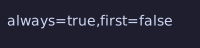
Case 4 (ok)
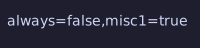
inheritFlags second --always --misc2

Case 5 (ok)
inheritFlags third --misc1
multiShortFlags
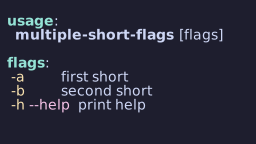
## Single-letter flag names are automatically short-only — no long form is generated.
import hwylterm, hwylterm/hwylcli

hwylCli:
  name "multiple-short-flags"
  flags:
    a "first short"
    b "second short"
  run:
    echo a, b
Case 1 (ok)
multiShortFlags --help
posBasic
## Positional arguments can bind to a different variable name in the run block via ident.
import std/[strformat]
import hwylterm, hwylterm/hwylcli

hwylCli:
  name "posBasic"
  positionals:
    input:
      T string
      ? "the \"input\""
      ident i
  run:
    echo fmt"input={i}"
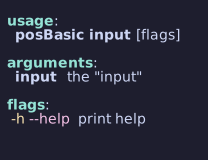
Case 1 (ok)
posBasic --help
Case 2 (ok)
posBasic a

posFirst
## A variadic positional can appear first, collecting values until the fixed positionals are satisfied from the right.
import std/[strformat]
import hwylterm, hwylterm/hwylcli

hwylCli:
  name "positionals"
  positionals:
    first seq[string]
    second string
    third string
  run:
    echo fmt"{first=}, {second=}, {third=}"
Case 1 (ok)
posFirst --help
Case 2 (ok)
posFirst a b c d e

Case 3 (error)
posFirst a b

posLast
## A variadic positional in the last position collects all remaining arguments after the fixed ones.
import std/[strformat]
import hwylterm, hwylterm/hwylcli

hwylCli:
  name "posLast"
  positionals:
    first string
    second string
    third seq[string]
  run:
    echo fmt"{first=}, {second=}, {third=}"
Case 1 (ok)
posLast a b
Case 2 (error)
posLast a

posNoMulti
## Positionals with non-seq types accept exactly one value each and support type coercion.
import std/[strformat]
import hwylterm, hwylterm/hwylcli

hwylCli:
  name "positionals"
  positionals:
    first int
    second string
    third string
  run:
    echo fmt"{first=}, {second=}, {third=}"
Case 1 (ok)
posNoMulti 5 b c
Case 2 (error)
posNoMulti 5 b c d

propagateSetting
## Settings flow down to subcommands by default; IgnoreParent opts out and per-subcommand settings extend or replace.
import hwylterm, hwylterm/hwylcli

hwylCli:
  name "setting-propagate"
  settings InferShort, LongHelp
  flags:
    [misc]
    input:
      T string
      * "the default"
      ? "input flag"
    count:
      T Count
      * Count(val: 0)
      ? "a count var with default"
  subcommands:
    [one]
    settings IgnoreParent
    flags:
      ^[misc]

    [two]
    settings HideDefault
    flags:
      ^[misc]
Case 1 (ok)
propagateSetting one -h
Case 2 (ok)
propagateSetting two --help
required
## Marking a flag Required causes the CLI to exit with an error if it is not provided.
import std/strformat
import hwylterm, hwylterm/hwylcli


hwylCli:
  name "required-flag"
  flags:
    input:
      S Required
      T string
      ? "a required flag!"
  run:
    echo fmt"{input=}"
Case 1 (ok)
required --input a

Case 2 (error)
required

Case 3 (ok)
required --help
subHooks
## preSub and postSub hooks run code around any subcommand dispatch, and can be nested per level.
import std/[strformat]
import hwylterm, hwylterm/hwylcli

hwylCli:
  name "subcommands"
  preSub:
    echo "preSub from root!"
  postSub:
    echo "postSub from root!"
  subcommands:
    [a]
    ... "subcommand 'a'"
    run:
      echo "inside sub 'a'"
    [b]
    ... "subcommand 'b'"
    run:
      echo "inside sub 'b'"
    subcommands:
      [a]
      ... "subcommand 'b a'"
      run:
        echo "inside sub 'b a'"
    [c]
    ... "subcommand 'c'"
    preSub:
      echo "preSub from 'c'!"
    run:
      echo "inside sub c"
    subcommands:
      [a]
      ... "subcommand 'c a'"
      run:
        echo "inside sub 'c a'"
Case 1 (ok)
subHooks a
Case 2 (ok)
subHooks b a
Case 3 (ok)
subHooks c a
subcommands
## Subcommands each have their own flags, positionals, aliases, and can use hyphenated names.
import std/[strformat]
import hwylterm, hwylterm/hwylcli

hwylCli:
  name "subcommands"
  V "0.0.0"
  subcommands:
    [help]
    [version]
    [a]
    ... "a subcommand with positionals"
    positionals:
      input string
      outputs seq[string]
    run:
      echo fmt"{input=} {outputs=}"

    [b]
    ... "a subcommand with flags"
    flags:
      input:
        T string
        * "testing"
        ? "some help after default"
      outputs:
        T seq[string]
    run:
      echo fmt"{input=} {outputs=}"

    [ccccc]
    ... "a subcommand with an alias"
    alias c
    run:
      echo "no flags :)"

    [dd-dd]
    ... "subcommand with hyphen"
    run:
      echo "not all hyphens are flags"
Case 1 (ok)
subcommands a b c
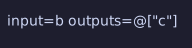
Case 2 (error)
subcommands b b c

Case 3 (ok)
subcommands b --input in --outputs out1 --outputs out2

Case 4 (ok)
subcommands ccccc
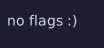
Case 5 (ok)
subcommands c
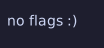
Case 6 (ok)
subcommands dd-dd

Case 7 (error)
subcommands e

Case 8 (ok)
subcommands help --help
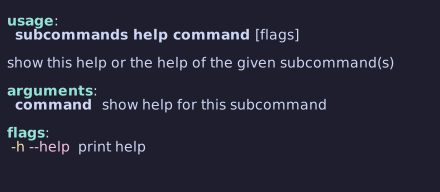
Case 9 (ok)
subcommands help dd-dd
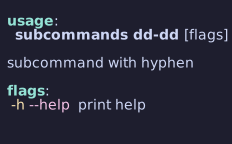
Case 10 (ok)
subcommands help c
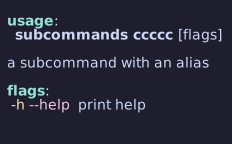
Case 11 (ok)
subcommands help
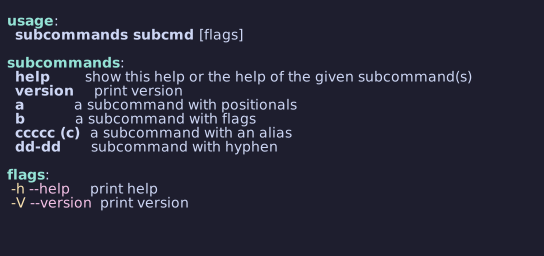
version
## Versions can be set using compile time defines or runtime code
import hwylterm, hwylterm/hwylcli

hwylCli:
  name "version"
  version "0.1.0"
  run:
    echo "hello world"
Case 1 (ok)
version --help
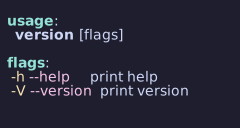
Case 2 (ok)
version --version
